
despair, or micro disciplined practices
by rita kaur dhamoon
August 4, 2025
I have not known how to write this inaugural blog of the IRK Lab…I have wrestled with not wanting to be so heavy with the weight of the world, and yet I cannot turn away from it…
Some months ago I read an instagram post (which I can no longer find! I wish I could!) that beautifully articulated that, for those of us who care about the state of the world, despair is manufactured in ways that make us feel that change is not possible, that we cannot stop the destruction or injustices. Nothing we do will stop genocides in Palestine or the Democratic Republic of Congo (DRC), or starvation in Sudan, or violence against Indigenous and Black women and trans people in Canada or the US, or mass displacement of people in Bangladesh due to climate change, or the destruction of the land and waterways in a multitude of places like the Amazon, or the violence and poverty in Haiti caused by colonial legacies, or the epidemic of murders of Dalit people in India, or …so many places and people killed, dying, hurt and suffering. None of these are singular of course, either. For instance, despite the insurgent action of front-line defenders in the DRC since at least 2007, ordinary people are wracked with severe poverty, environmental destruction, forced movement, pollution, child slavery, major deadly illnesses because of mining from foreign corporations and governments.
The instagram post made a direct link between the despair I was feeling and the capitalist imperative of profit making; the global rise of fascism that imposes patriarchy, white supremacy/caste supremacy, authoritarianism, and hegemony; and the imperial drive for even more possession and exploitation of natural resources and marginalized people.
“Despair,” says Dra. Rocio Rosales Meza, “is what the colonizer wants”.
Despair shows up in many ways - as apathy, weakened community relations, disengagement from activities, fatigued and ill bodies (of course, not only because of despair), dulled senses, disinterest in basic tasks, and loss of faith in humanity. Despair becomes internalized such that we give up on the possibility of alternatives, a different world, different kinds of relationships and power dynamics. As Ngugi Wa Thiong'o (1986, 3) said,
…the biggest weapon wielded and actually daily unleashed by imperialism against that collective defiance is the cultural bomb. The effect of a cultural bomb is to annihilate a people's belief in their names, in their languages, in their environment, in their heritage of struggle, in their unity, in their capacities and ultimately in themselves. It makes them see their past as one wasteland of non-achievement and it makes them want to distance themselves from that wasteland. . . . It even plants serious doubts about the moral rightness of struggle. Possibilities of triumph or victory are seen as remote, ridiculous dreams. The intended results are despair, despondency and a collective death-wish.
Yet, the instagram post, that I wish I could find again, also said that despair diverts resources from collective action (paraphrased). And that we could redirect individual and collective despair towards mobilizing for the movements we care about.
It was then that I realized numerous things:
That despair was enforced on us, as a condition of muting us, making us feel paralyzed, so that we didn’t act against injustice and hegemonies of rule and control.
That I was using my limited internal resources on despairing and not on action.
My despair was leading me to give up the struggles I had been active in for over 30 years.
That millions of people in the world who are suffering, and who get little, if any, reprieve from conditions not of their making (like war or occupation or climate change disasters) were viscerally experiencing despair in ways that my privilege (of having higher education, living in a G7 country, owning property, having regular income, speaking a dominant language, being in a heteronormative relationship) let me escape from.
That despite the ongoing onslaught of capitalist, fascist, and imperial/colonizing violence, the ordinary people of Gaza, the DRC, Sudan, Bangladesh, Haiti, India were resisting their annihilation.
That despair is informational - the somatic and embodied encounters of despair tell us that we care about the world, both human and more-than-human.
Despair enables us to see what is damaging, violent, corrupt; it lets us question the governing institutions and ideologies that produce the conditions of despair.
It’s not that my despair has gone now. Rather, I have a deep sense of wanting to counter it so that even if hegemonic ideologies and people and institutions ‘win’, resistance is not futile.
I started doing more small things that mitigated my despair. In part, these were small because of my own physical limitations. I started creating political art. It started with painting watermelons and symbols of ‘Free Gaza, Free Palestine’ on canvas.

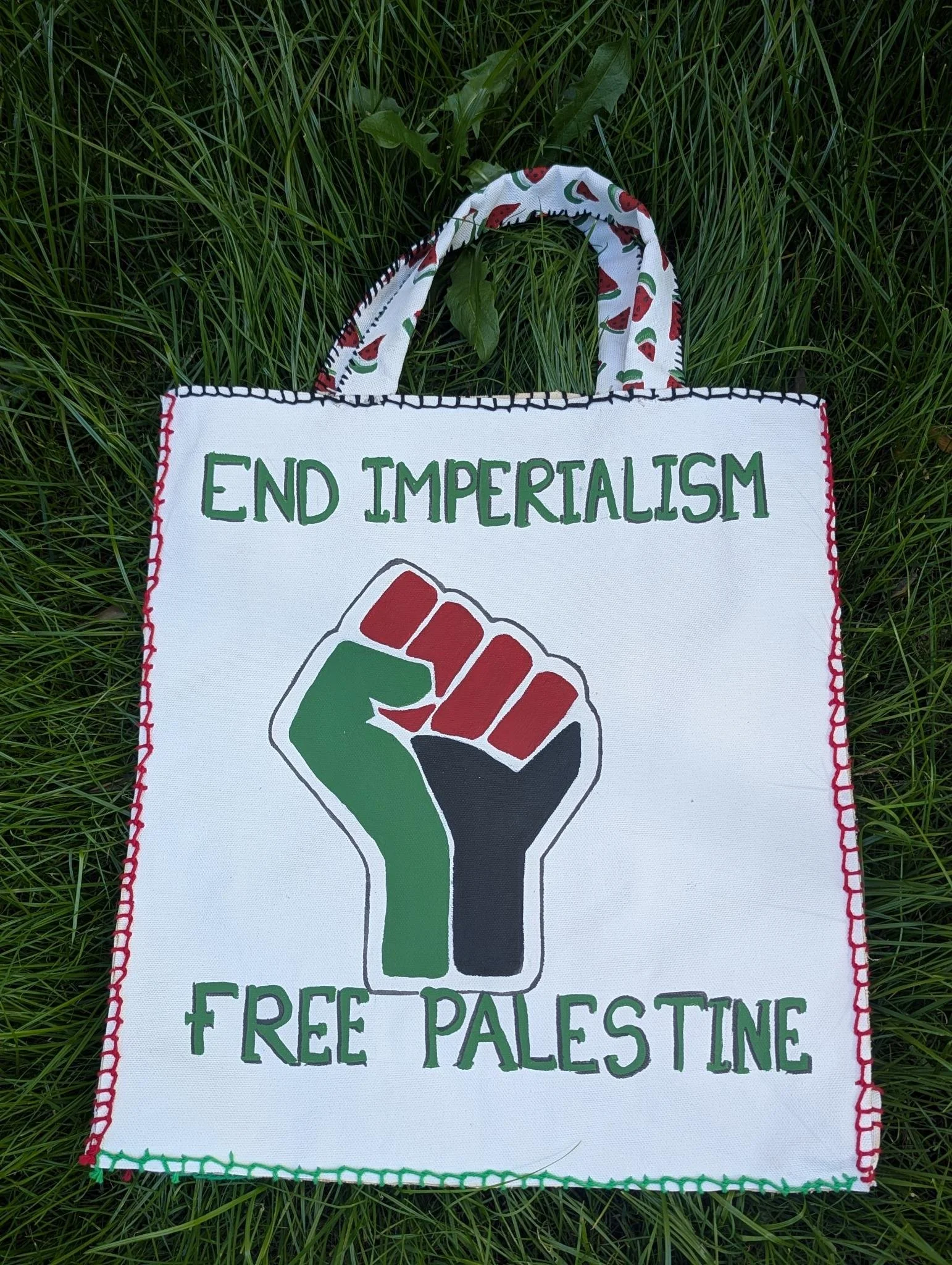
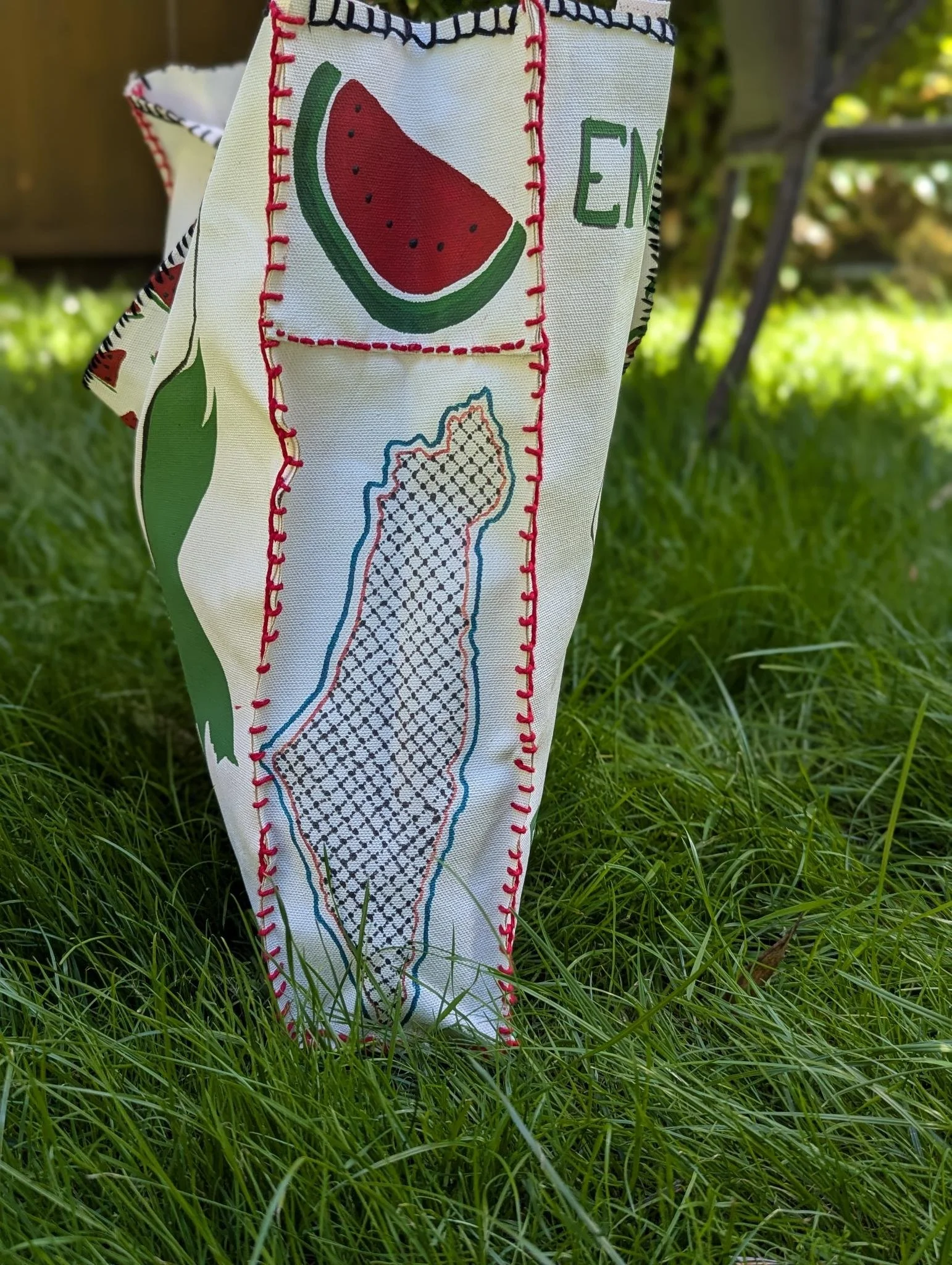

Then, I started a new bag on socio-economic and ecological devastation happening in the DRC. I had been reading more about the DRC, and learned from Anita Girvan about how the issues facing the people there were typically framed as an ethnic conflict, but in fact were a direct result of resource mining by western corporations who made products that many of us heavily use in everyday products like smartphones.
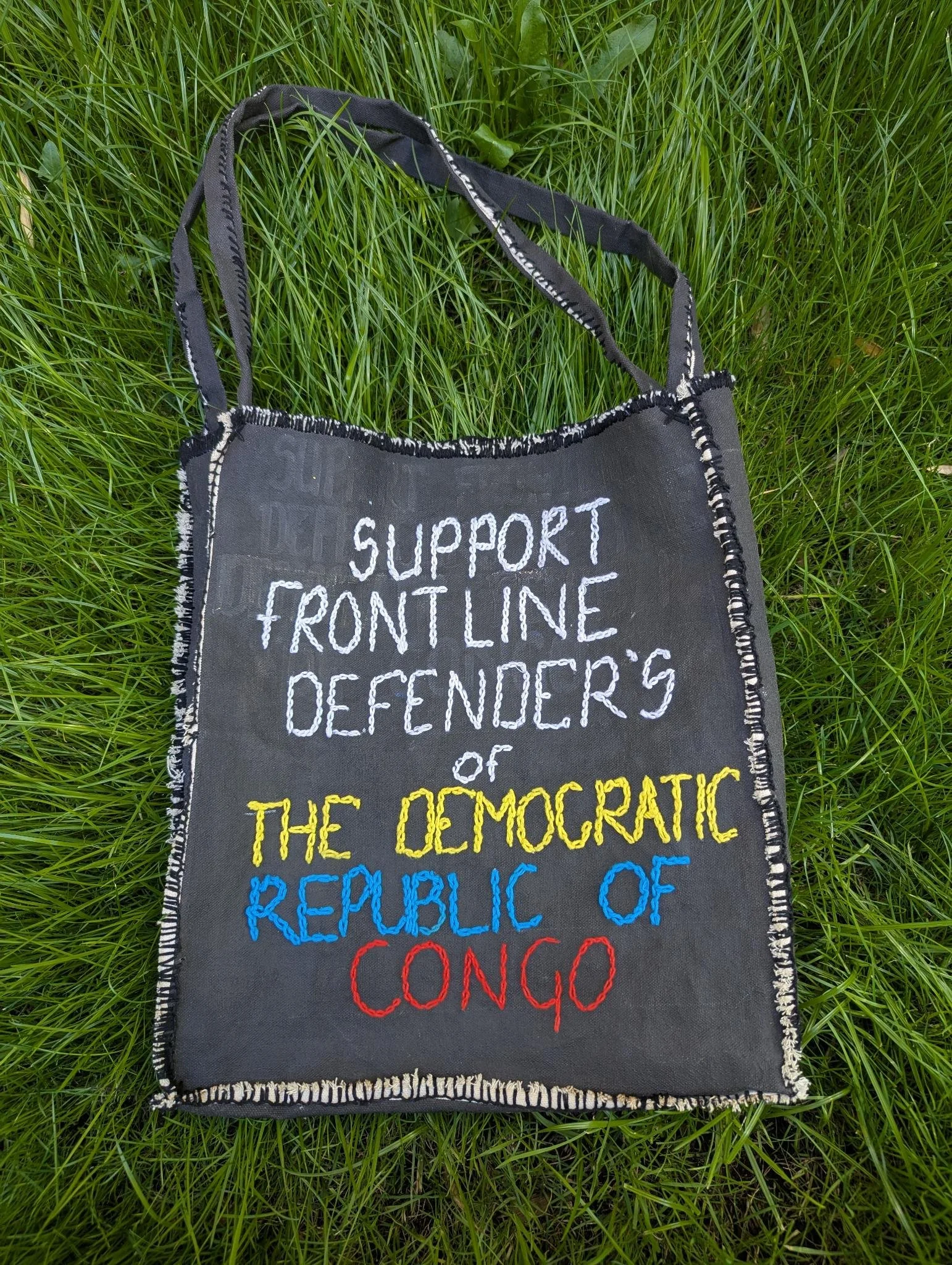
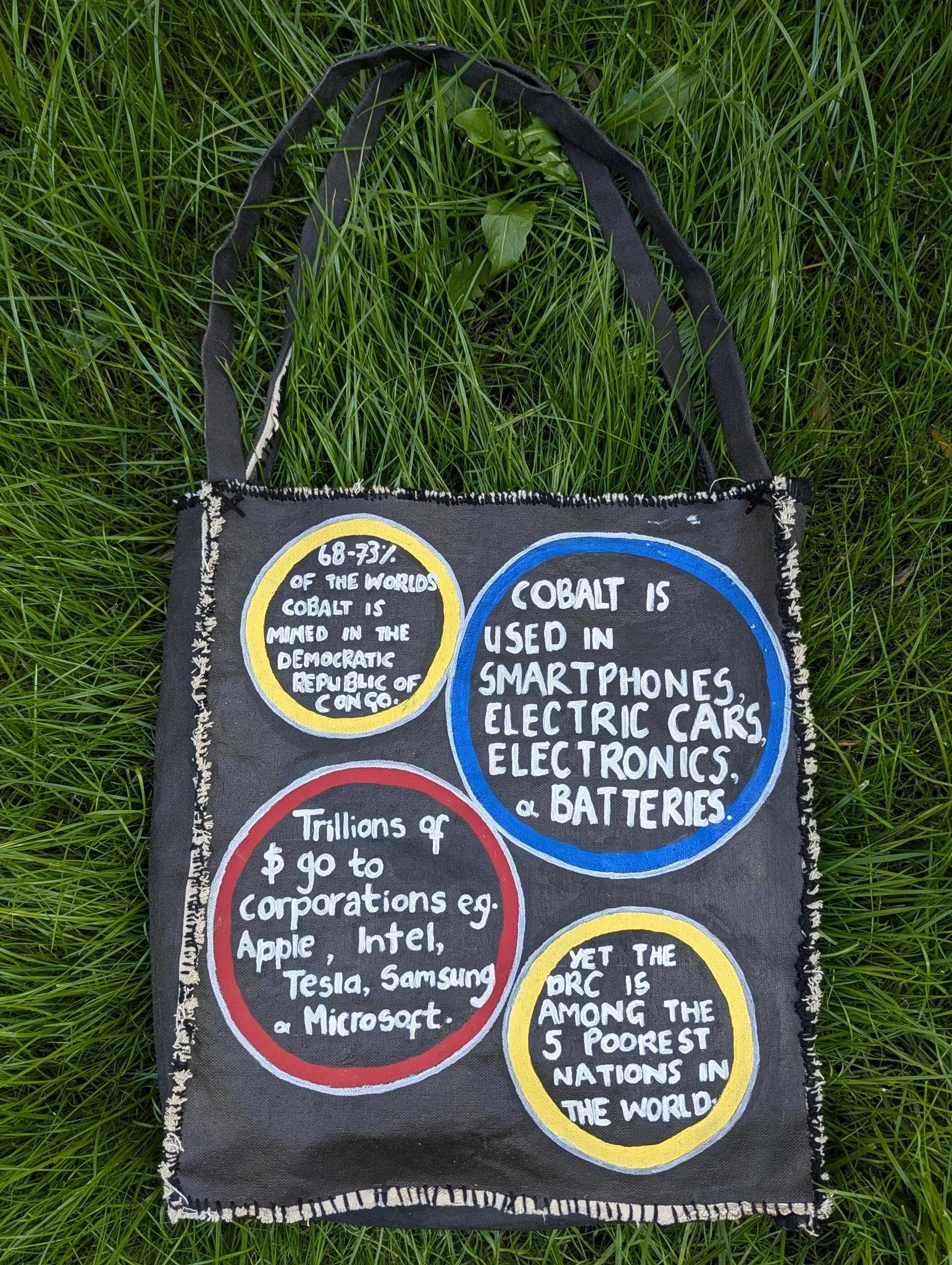
I wanted to affirm Anita’s care for the DRC and I wanted others to know how terrible the conditions were - the bag became a micro version of public education via art.
Then I gifted my IRK Lab sisters the bags, knowing that they cared about the issues that were the focus of the art. Their unexpected delight led us to conversations about making such bags in community with others. In doing so, we could learn about different issues collectively, and wear our art publicly. My despair waned a bit more.
I have since worked on two other canvas bags (canvas about $5 each), using embroidery thread ($1.75/colour) as well as inexpensive metallic acrylic paints ($7.50 in total). In doing so, I have learned about key aspects of ecological liberation that are entangled with human liberation.


I have also learned more about international worker solidarity for Palestinian freedom, and reviewed key aspects of abolition feminism.


What I have come to learn is that to rile against despair means that I have to intentionally practice not being despairing. And for me, one avenue has been making political art on a regular, almost daily, basis, even if only for a short time. It is a version of enacting ‘Hope as Discipline’, a concept that I learned from Anita, who learned about it from Nisha Nath, who read a quote from Mariame Kaba’s book, who in turn learned about it from a nun. Kaba says,
I always tell people, for me, hope doesn’t preclude feeling sadness or frustration or anger or any other emotion that makes total sense. Hope isn’t an emotion, you know? Hope is not optimism….
…The hope that she [the nun] was talking about was this grounded hope that was practiced every day, that people actually practiced all the time.
I take a long view, understanding full well that I’m just a tiny little part of a story that already has a huge antecedent and has something that is going to come after that. I’m definitely not going to be even close to be around for seeing the end of it. That also puts me in the right frame of mind: that my little friggin’ thing I’m doing is actually pretty insignificant in world history, but if it’s significant to one or two people, I feel good about that. If I’m making my stand in the world and that benefits my particular community of people, the people I designate as my community, and I see them benefitting by my labour, I feel good about that.
Kaba goes on to say that her focus is on testing her practice with other people, as this serves to collectivize care.
And so, what I have learned is that little practices that we undertake in a disciplined way, in which we condition ourselves to not be despairing – rather than Foucault’s conception of discipline! - is a way to move towards community and collective action for the world we care about.
It is not for everyone. Nor is it everything. But such discipline in micro-practices have a long history of mitigating against modes of despair that produce inaction, especially by women. It is one way that may help us through our current conjuncture…I hope.
References
Mariam Kaba. We Do This ‘Til We Free Us: Abolitionist Organizing and Transforming Justice. Chicago: Haymarket Books, 2021.
Ngugi Wa Thiong’o. Decolonising the Mind: The Politics of Language in African Literature. Portsmouth, NH: Heinemann, 1986.